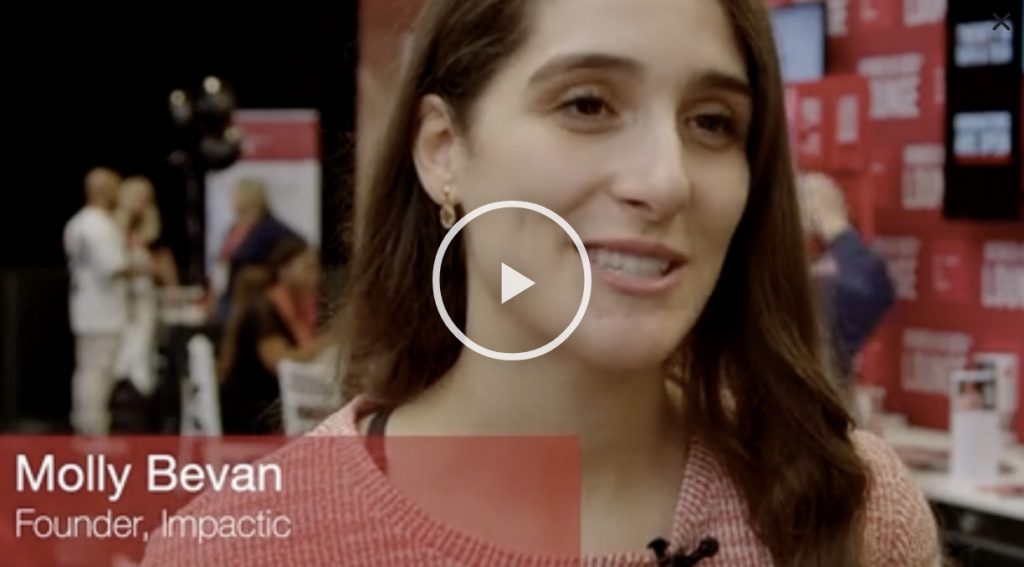
As the founder of her own social enterprise, Impactic, Molly’s journey into Data has been nothing short of inspiring. Following a Graduate Programme at Accenture and hands-on volunteering with Mind, she gained an early, unfiltered view of how talent, time, and good intentions often fail to meet real social need.
By connecting those experiences, she identified a clear niche, where untapped corporate services could unlock social impact. Today, her Data4Good organisation is addressing a striking inefficiency whilst building confidence, capability, and purpose for professionals alongside.
Molly’s leadership and commitment were recognised as part of the Women in Data® Twenty in Data & Tech, Series 7 when she was noted as a Rising Star for exemplifying the principles of Data4Good. Alongside, she’s growing a list of industry accolades including Aspen Institute Rising Leaders Fellow and University of Exeter Startup Rising Star award in 2022. We caught up with Molly recently to hear more about the impact of her work.
When you started Impactic, what industry problem were you responding to?
In the UK alone, 140 million workplace volunteering hours go unused every year. I founded my social enterprise, Impactic, in 2022. By partnering with businesses and charities, we channel this untapped potential into solving real-life challenges. I work with businesses including Microsoft, Grant Thornton and PwC. To date, Impactic has generated close to £1 million in pro bono professional services, enabling individuals to apply and develop both hard and soft skills, while charities gain access to expertise they would otherwise be unable to afford. I feel incredibly proud and energised to continue scaling my organisation for meaningful impact.
Can you tell us about your journey into data?
 During the pandemic, I volunteered for six months at my local branch of Mind, where I first saw how powerful data could be in shaping strategy and funding decisions in the charity sector. I later joined Accenture as a graduate, building strong technical and commercial foundations. Over time, however, I experienced burnout from operating in a context that didn’t fully align with the impact I wanted to create. After witnessing the underuse (and huge potential!) of corporate volunteering first-hand, I founded Impactic.
What’s changed since we last caught up with you?
The biggest shift is momentum – it feels less like pushing uphill and more like building an ecosystem around skills for good. We’ve expanded delivery and built repeat partnerships, seeing organisations embed Impactathons into longer-term strategies.
I’m especially excited to be growing the team, bringing on the talented Inès Bussat as Head of Programmes, which marks a real transition from founder-led delivery to team-led scale. Building alongside someone whose values align with the social enterprise feels incredibly energising. I’m looking forward to seeing what’s possible as we continue to grow sustainably and intentionally.
As a self-taught data analyst, when did you realise data wasn’t just a skill, but your calling?
During my time volunteering with Mind, I recognised a significant data skills gap in the charity sector. When resources are limited, every decision carries weight – and data can bring clarity, strengthen funding cases and sharpen strategy. I saw how the right insights could transform uncertainty into confident action.
That belief scaled dramatically during the Women in Data® Impactathon, where 300 volunteers analysed the UK’s first nationwide survey on the societal and economic impact of violence against women and girls. In fact, I still reflect today on this as one of my proudest moments.
Seeing data shape real-world conversations and inform decision-making cemented it for me: it’s not enough to understand data, it must be applied for good!
Tell us more about the essence to Impactic’s purpose?
Impactic transforms underused corporate volunteering into measurable, skills-based impact. Both the economy and wider society could benefit considerably if these wasted volunteering days were put to good use.
We redesign this wasted potential into structured, one-day Impactathons where professionals apply expertise in data (as well as other skills, including finance, marketing, strategy) to solve real charity challenges.
What makes the model different from traditional corporate volunteering is its intentional design: charities receive tangible deliverables they can implement immediately, businesses see clear ROI through engagement and retention, and volunteers build confidence, apply their skills in new contexts and create meaningful impact. It’s a genuine win-win-win.
What other communities are you part of and why is this important for your business?
I am part of the Global Shapers Community, as Founding Curator of one of the London Hubs and UKI Community Champion. It is an initiative of the World Economic Forum, with a network of 11,000+ young changemakers across 500+ hubs in 150+ countries. Together, we’re driving dialogue, action, and change on the world’s biggest challenges – from climate to equity to mental health. This community has been one of the most meaningful parts of my life – I’m endlessly inspired by the talent, kindness, and bold ideas from all the Shapers I’ve met along the way.
I also became a World Economic Forum Fellow through my work on their Responsible Leadership Programme.
Impactathons are a core part of your model – what are they, and why do they create such a powerful, safe space for people to build their skills and confidence?
Impactathons are high-energy, carefully facilitated workshops where professionals collaborate to solve live charity challenges in a single, focused day. We intentionally create a space which feels safe, so volunteers can apply and develop their skills (both hard and soft), growing their confidence. I’ve watched many women, including mothers returning from maternity leave, rediscover their professional identity in those rooms. They’re reminded that their skills are valuable, relevant and powerful.
You were recognised within the Twenty in Data & Tech as a rising star who truly embodies Data4Good – what does that recognition mean to you, and how has your career changed since being awarded the accolade?
It gave credibility at a pivotal stage. Being recognised alongside industry leaders reinforced that Data4Good isn’t niche – it’s necessary. It positioned Impactic within a wider network of women and allies shaping the future of tech and impact.
“The recognition opened doors to new partnerships and speaking opportunities, but more importantly, it shifted how I saw myself. I moved from feeling like an outlier pushing an unconventional idea to operating with confidence that measurable, impact-driven data work belongs at the centre of serious industry conversations”.
Your journey from being self-taught to running your own business is inspiring. What skills have you picked up along the way?
Entrepreneurship means wearing all the hats – from sales and marketing to finance, delivery and strategy – sometimes within the same day! I love the art of cross-sector translation: aligning corporate objectives with charity realities, while ensuring measurable outcomes for everyone involved. Through it all, I’ve been reminded that impact is built on human connection. No matter how data-driven the work is, people sit at the centre – and that’s a principle I consciously live by, both in my work and beyond.
For anyone thinking about putting themselves forward or nominating someone else for the Twenty in Data & Tech Series 9, what would you say?
Do it… especially if you’re hesitating! Visibility matters, and recognition isn’t about ego – it’s about amplifying the kind of impact you want to see more of in the industry. The process itself builds confidence, and the community you step into is powerful and inspiring. Often the people doing the most meaningful work are the least likely to self-promote. Back yourself, or back someone else by nominating them.
“When we champion each other, we don’t just celebrate talent, we also accelerate progress for everyone. The ripple effect of your nomination could be bigger than you realise”.
Thinking back to the run-up to the award announcement, what do you remember?
I remember being excited – not about the outcome, but about discovering who else had been selected, and how their stories would be brought to life by the brilliant Sane Seven. There’s something powerful about recognising the collective talent around you. I imagine Series 8 are experiencing a mix of emotions, as it’s a really special moment – not just personally, but because it reflects the growing momentum of women shaping the future of data.
What does progress feel like to you in the industry today?
Progress, to me, feels like seeing more women in rooms where decisions are actually made. It feels like holding ourselves to a higher standard when we talk about impact, moving beyond nice dashboards to real accountability and action. I’m encouraged by how seriously Data4Good is now being taken, with real rigour and collaboration behind it.
There’s still a long way to go, but the shift is real. More women are stepping forward, refusing to separate what they care about from the work they lead.