Laura has built one of the most effective data science teams in government, including creating an open-source API which is used in 10 Downing Street. She was awarded a CBE for Services to Technology and Analysis.
Under Laura’s leadership, her teams have provided fast-paced modelling and analysis that support policy making and delivery, to rapid prototyping to speeding up government innovation.
With a Doctorate in Particle Physics and Computing from Oxford, she has an Undergraduate degree from Cambridge and is a visiting professor at London School of Economics and Policy. She plays the piano, oboe and harp and has competed for Britain 7 times in Savate kickboxing.
We caught up with Laura to explore her career path and the ethos that has shaped her commitment to work with real purpose.
You’ve established a significant career in data science across government. What experiences or moments stand out along the way?
In 2023, I created the incubator for artificial intelligence, which is still going strong now. It’s one of the first efforts among governments to design and build an API project with real engineering rather than pure strategies, frameworks, and governance. I left in January 2025, went very briefly to the Ellison Institute, and then the programme moved to the Tony Blair Institute. Today, I’m responsible for running the ‘AI for government programme’. We’re building tools to help governments make evidence-based decisions with artificial intelligence.
Our work is centred around answering the questions that matter most to governments – questions that shape policy. We look beyond data and evidence alone, drawing on behavioural science to better understand how and why decisions are made. This shift from simply knowing what happens to understanding why it happens can fundamentally change the conversation and critical when addressing complex challenges such as unemployment or homelessness.
“It’s about making better outcomes for our society, based on the amount of money you’ve got available, and changing decision making to be more rational”.
What impact are you most proud of creating through your work with data?
It’s actually quite hard to pinpoint one, as there has been many stand out moments for the team. One that I’m particularly proud of is providing modelling for most of the Prime Minister’s big decisions over four and a half years. The bit that I mostly enjoyed was creating a programme called ‘Evidence House’.
It was essentially a grassroots project in government that encouraged anyone interested in data science a space to innovate, learn and the ability to do things differently. Through the project, we worked with some generous tech companies who offered their support, universities who offered us space – whilst we offered free data science upskilling and essential training in core packages such as Python. We held hackathons aligned to real government problems – such as ‘how do we protect people from fraud’? And how do ‘we prove health outcomes’? by mixing teams with a combination of skills – such as product, policy or coding experience. By the time I left, we had supported c.17,500 hours of free AI skilling that were aligned to real solutions that are used in Government today. Through gradual adoption, we created a powerful buzz and cultivated a community who were committed to driving meaningful societal change.
When you look back on your career, did you ever imagine the impact and success that your career would actually have?
Not really. My career, if I’m honest, has been shaped by a series of accidents. I began with a clear plan. After studying at Oxford University, I intended to become a Particle Physicist. Everything seemed to be mapped out.
But over time, what mattered more to me than sticking to a plan was finding real meaning in my work. When people ask me for career advice now, that’s always where I start. I’ve needed to feel not only proud of what I do, but genuinely challenged by it. I have a low tolerance for boredom, and as you get older, that instinct has only sharpened.
When I was in physics, I was really enjoying myself. I was working in Oxford and doing a lot of teaching, which I loved. However, it was in 2009 when the government cut c£80 million pounds worth of funding, directly impacting the value of research to focus on its economic output. Consequently, I turned down an opportunity to work in Chicago. Instead, I went to the career service and said, “what could I do where having a degree in particle physics is a prerequisite – because I don’t want to feel like I have wasted my time”. That led me to working in quantum finance for a few years on Hedge funds. However, after a few years it just didn’t have the same technical buzz.
A friend from graduate school started a medical tech company from scratch, but didn’t have money to pay engineers. I decided to help him on the side of my day job, taught myself everything from building android and iOS apps to cloud architecture and cybersecurity. As the company grew, I became CTO and built the engineering team. We had essentially no fails and zero downtime of our services, integrated with the NHS and supported thousands of individuals with multiple and complex needs including severe learning difficulties to better health. We sold it after a little over 9 years, by which point we were pretty exhausted. It was soon after this that I came across the opportunity to work at Downing Street.
“It’s a space I really love working in. And if you’ve got that combination of it being interesting, allowing you to problem solve whilst also making an impact, and seeing changes in people’s lives as a result – then that’s a dream job, really”.
Tell us more about your association with Women in Data®. What does this community mean to you, and why has it stayed such a central part of your journey?
I went to an event and really enjoyed it. It’s genuinely full of women and allies that are supportive of this mission which is fantastic. There really is still a bit of a vacuum in the data space, and I noticed it particularly in government, but also when I was in medtech.
However, attitudes to success are very much central to the equity problem. We’ve all been there where – you don’t want to push yourself forward because, it’s perhaps not how you’re conditioned to work. I’ve mentored quite a few younger women, and I remember one of them had done some phenomenal work. It was groundbreaking and completely changed the way government did everything. She found it difficult to take personal credit for the work, or to put herself forward for a promotion that she had clearly earned. Instead, she took quiet satisfaction in simply seeing the work done.
I champion women in this space. It’s important to know how to enter a room, what to say and where you sit down, especially in Cabinet Office where the ratio of women is about 35%.
What does that recognition mean to you?
The Twenty in Data & Tech Award is pure celebration. It creates an experience for
a group of women to reflect on their achievements. For me, it was very humanising. It didn’t feel like competition. There’s not a ranking associated with it. I’m on a number of lists, and that’s quite a competitive thing – there’s no joy involved in any of it.
With this award, you’re not just being recognised, you’re part of a celebration and representing the power of collective impact.
What does progress feel like to you in the industry today?
There are real worldwide issues that everyone I’m sure is familiar with. However, the things that keep me up at night, is the degree to which safety remains a real problem. Whilst we’re focusing on evidence, we need to prioritise the technology’s impact to psychology and society. I worry about the ability of the non-superpowers such as maintaining the culture, history, language, values and ethics in a world where the majority of people are using large language models developed by people with potentially quite different ideas of what the world looks like. The question of sovereignty is going to be incredibly important worldwide, for most governments.
The ability to be resilient, and not reliant on external systems for citizens to achieve enhanced well-being, health and prosperity is so important.
In the era of AI, Data roles are evolving so rapidly – how do you manage to stay adaptable while continuing to lead with confidence?
When I was a Particle Physicist, the amount of physics that you could learn became more and more niche. By the time I left, I pretty much could do deep in elastic scattering. AI is different. It’s really hard work to try and even keep a basic grasp of.
I think you kind of crowdsource. There are a lot of WhatsApp groups, I speak on a lot of panels, I go to a lot of conferences and get the opportunity to hear what other people are up to. But it’s not as simple as it used to be. You can’t just pick up a trade paper anymore and it will tell you everything you need to know.
My ambition probably isn’t to be fully up to date on everything, but to understand enough about what I don’t know and know who to ask.
For anyone thinking about putting themselves forward or nominating anyone else for the Twenty in Data & Tech award, what would you say to encourage them?
If you’re thinking about submitting a nomination, I think it can have a real impact on somebody’s life. It really is a wonderful thing to do for another woman who inspires you. Putting the effort into saying why you think this person is changing the world a little bit is so encouraging, especially within the 100k plus community like Women in Data®.
“It feels like being part of a movement and it’s a very joyful movement”.
Thinking back to the run-up to the award announcement, what do you remember experiencing?
I was really excited. I didn’t quite know what to expect. But you do feel a bit like a queen. I really, really enjoyed it. The event was fantastic, and I remember a lot of fireworks and women in red laughing, which is always a good way to spend the day
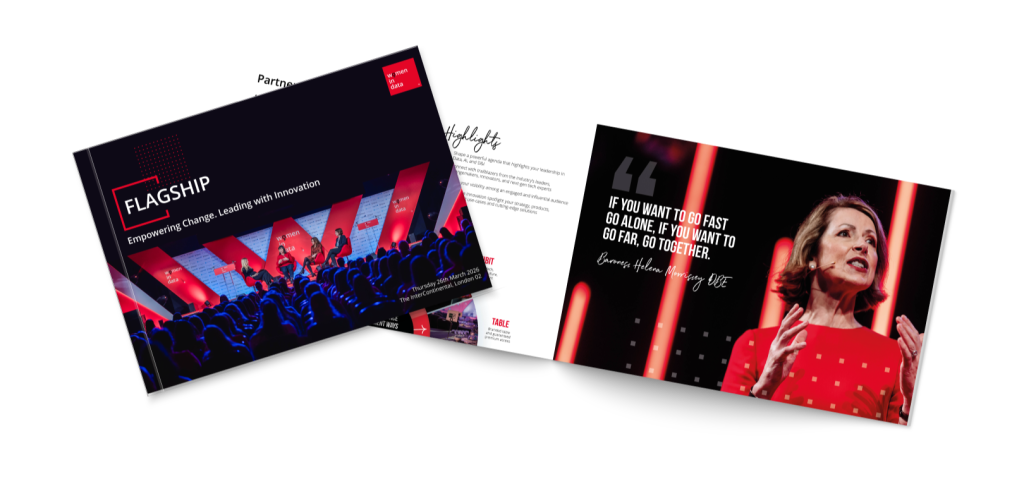
Fill out the form below to receive our comprehensive partnership brochure.