Since starting her career as a Junior Data Analyst, Joanna has built a path driven by passion and purpose. Today, she is thriving and working in a sector that perfectly reflects her lifelong love of sport.
What began as an organic step into data has evolved into a career that aligns closely with her values. Outside of work, she lives that ethos daily, balancing everything from korfball and pole fitness to yoga, Pilates and CrossFit.
We caught up with Joanna three years on from being granted the Rising Star Award in the Women in Data® Twenty in Data & Tech Series 5 – an accolade that recognised her as one of the industry’s most exciting emerging talents. Now, just weeks into a new role with the Cricket Regulator she reflects on her journey so far, and the impact that being recognised as a Twenty in Data & Tech Rising Star has had on her career.
You’re working in a dream data role. Have you always had a passion for sport?
Sport has always been a part of my life. I was an active child and grew up playing all the traditional team sports. Academia took me in a different direction – I studied Politics and International Relations at university, followed by Social Research Methods and Statistics. A career in sport wasn’t something I had originally planned or intended.
The transition to working in the sports industry came from a happy coincidence when I applied for a junior analyst role six years ago. Since then, I’ve built my career entirely within the sports sector, progressing through four roles along the way. It’s an industry I feel incredibly grateful to be part of and one I genuinely love working in.
Can you tell us about where you are working now?
I’ve recently moved on from a role at the UK Sports Institute, an organisation funded by UK Sport and the National Lottery that works across the Olympic and Paralympic programmes. Their remit spans from swimming and weightlifting through to snowboarding, all with a focus on answering the critical performance questions such ‘how to win medals’ and ‘how to be better’.
I worked in a consultancy type role, supporting everything from performance optimisation across multiple programmes, to proposing data strategies, through to helping internal teams with their data needs particularly loved the variety the role offered and the opportunity it gave me to apply data in ways that had a direct impact on elite and internal business performance.
Just recently, I’ve transitioned to working in cricket. I work for the Cricket Regulator, which is part of the England & Wales Cricket Board (ECB) and my work will be focused on their key strategic areas; anti-discrimination, safeguarding and anti-corruption. I’m the first dedicated data insight person they’ve got in the organisation.
“I love playing and working in sport. It’s fun, it’s relaxed, it’s fast-paced and it’s kind of everything that I’d want out of an employer and a job”.
You were recognised for being a rising star after your work in British Cycling?
Yes. At the time, I shared quite openly on LinkedIn about the research I’d been doing at British Cycling, where I explored the enablers and barriers to cycling across the British population particularly among underrepresented groups such as women, ethnically diverse communities, and LGBT+ individuals. I was also vocal about the inequities that exist within sport more broadly, and I cared deeply about making cycling more inclusive and accessible to everyone. I think that passion and honesty caught some attention. During my time at British Cycling, and even in my previous role, I had the chance to speak at a few early career events at my old university, which I absolutely loved. But to be completely honest, I’m still not entirely sure what specifically earned me the ‘Rising Star’ recognition. I suspect someone saw something in me at a time when I didn’t fully see it in myself. I have a good idea of who nominated me, and I’ll always be grateful to them.
How would you say your career has changed since being awarded the accolade?
The biggest change has been personal growth, particularly the confidence I’ve gained. In terms of my day-to-day work, the level of responsibility hasn’t shifted dramatically. I’ve always worked independently, presented to Senior leaders, managed my own time and projects, and taken ownership of what I do.
What has evolved is the nature of my work. It’s become more strategic, and I have a greater focus on the bigger picture. Without a doubt, the most significant shift has been in how I see myself. I feel far more self-assured – I know who I am, what I stand for, and the values and morals that guide my decisions. I’m also much more confident in articulating my skills, my value and what I bring to a role. I’m also so much more patient and really enjoying my journey.
The accolade also helped grow my network considerably. I now have a strong community I can turn to for support, and that sense of connection has been incredibly valuable. I’ve been given more opportunities to speak, from engaging with early-career professionals to visiting organisations across the sports industry which I’ve thoroughly enjoyed.
Perhaps most rewarding of all has been the chance to give back. I’m regularly contacted on social media by young people, particularly young women, who are starting out in their careers and looking for advice. Being able to support and encourage them has been a real highlight.
In that same year I got on to the Sports Industry Next Gen leadership development programme. It accepts between 20 and 30 applicants a year, so it’s highly competitive. For me, it really was a pivotal year.
Are these new-found skills something you adopt in your career now?
Absolutely. I now see these skills as core to my leadership rather than separate from it. Self-reflection plays a huge role in how I work now, assessing what went well, what could be improved, and how to apply those lessons going forward. I’m much more intentional about using my interpersonal strengths to support my leadership and career progression. I’m also so much more patient based on what I have learnt and I’m really enjoying my journey.
For anyone thinking about putting themselves forward or nominating anyone else for the Twenty in Data & Tech award, what would you say to encourage them?
I would say, just go for it and just challenge yourself; you literally have nothing to lose.
That’s something that I do more now – I put myself out of my comfort zone. If there’s something that comes up that and my immediate reaction, is I don’t want to do it, I’ll try and make myself.
Thinking back to the run-up to the award announcement, what do you remember experiencing?
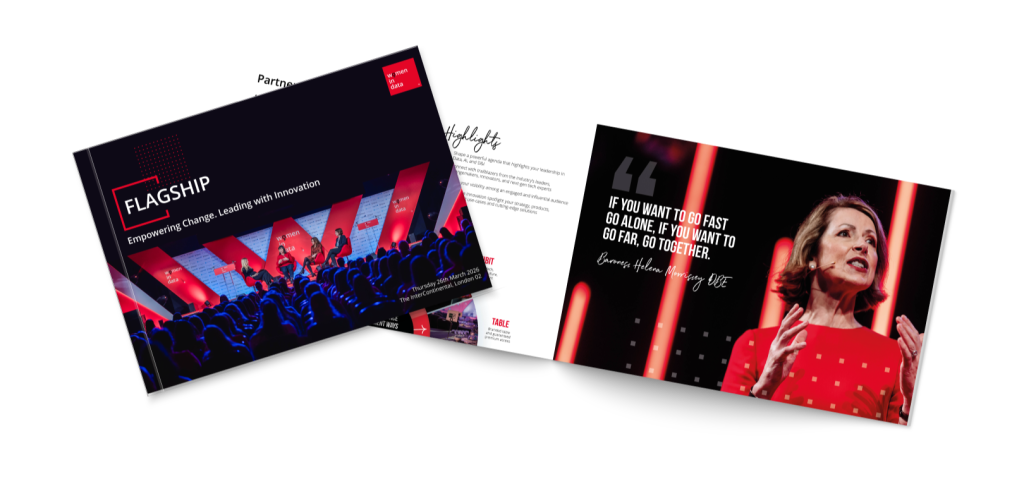
I was looking forward to it. I was absolutely buzzing because I’d also never been to the Flagship conference before. There was the excitement of going to the conference first time and then meeting everyone.
At the time, my new employer went to the conference and exhibited as well – so it was double the excitement.
What does progress feel like to you in the industry?
I can’t say that much has changed three years ago. There still needs to be more opportunities for women – it’s a wider societal issue. However, the past few years have taught me about the power of network and the impact of connecting with other women from across the data industry.
Having a few people you can talk to outside of your organisation who work in a similar space has been a game changer – sharing the joys, debating the challenges and considering solutions.